gui_State.gui_Callback = str2func(varargin{1});
end
if nargout
[varargout{1:nargout}] = gui_mainfcn(gui_State, varargin{:});
else
gui_mainfcn(gui_State, varargin{:});
end
% End initialization code - DO NOT EDIT
%--------------------------------------------------------------------------
% --- Executes just before FR_Processed_histogram is made visible.
function FR_Processed_histogram_OpeningFcn(hObject, eventdata, handles, varargin)
% This function has no output args, see OutputFcn.
% hObject handle to figure
% eventdata reserved - to be defined in a future version of MATLAB
% handles structure with handles and user data (see GUIDATA)
% varargin command line arguments to FR_Processed_histogram (see VARARGIN)
% Choose default command line output for FR_Processed_histogram
handles.output = hObject;
% Update handles structure
guidata(hObject, handles);
% UIWAIT makes FR_Processed_histogram wait for user response (see UIRESUME)
% uiwait(handles.figure1);
global total_sub train_img sub_img max_hist_level bin_num form_bin_num;
total_sub = 40;
train_img = 200;
sub_img = 10;
max_hist_level = 256;
bin_num = 9;
form_bin_num = 29;
%--------------------------------------------------------------------------
% --- Outputs from this function are returned to the command line.
function varargout = FR_Processed_histogram_OutputFcn(hObject, eventdata, handles)
% varargout cell array for returning output args (see VARARGOUT);
% hObject handle to figure
% eventdata reserved - to be defined in a future version of MATLAB
% handles structure with handles and user data (see GUIDATA)
% Get default command line output from handles structure
varargout{1} = handles.output;
%--------------------------------------------------------------------------
% --- Executes on button press in train_button.
function train_button_Callback(hObject, eventdata, handles)
% hObject handle to train_button (see GCBO)
% eventdata reserved - to be defined in a future version of MATLAB
% handles structure with handles and user data (see GUIDATA)
global train_processed_bin;
global total_sub train_img sub_img max_hist_level bin_num form_bin_num;
train_processed_bin(form_bin_num,train_img) = 0;
K = 1;
train_hist_img = zeros(max_hist_level, train_img);
for Z=1:1:total_sub
for X=1:2:sub_img %%%train on odd number of images of each subject
I = imread( strcat('ORL\S',int2str(Z),'\',int2str(X),'.bmp') );
[rows cols] = size(I);
for i=1:1:rows
for j=1:1:cols
if( I(i,j) == 0 )
train_hist_img(max_hist_level, K) = train_hist_img(max_hist_level, K) + 1;
else
train_hist_img(I(i,j), K) = train_hist_img(I(i,j), K) + 1;
end
end
end
K = K + 1;
end
end
[r c] = size(train_hist_img);
sum = 0;
for i=1:1:c
K = 1;
for j=1:1:r
if( (mod(j,bin_num)) == 0 )
sum = sum + train_hist_img(j,i);
train_processed_bin(K,i) = sum/bin_num;
K = K + 1;
sum = 0;
else
sum = sum + train_hist_img(j,i);
end
end
train_processed_bin(K,i) = sum/bin_num;
end
display ('Training Done')
save 'train' train_processed_bin;
%--------------------------------------------------------------------------
% --- Executes on button press in Testing_button.
function Testing_button_Callback(hObject, eventdata, handles)
% hObject handle to Testing_button (see GCBO)
% eventdata reserved - to be defined in a future version of MATLAB
% handles structure with handles and user data (see GUIDATA)
global train_img max_hist_level bin_num form_bin_num;
global train_processed_bin;
global filename pathname I
load 'train'
test_hist_img(max_hist_level) = 0;
test_processed_bin(form_bin_num) = 0;
[rows cols] = size(I);
for i=1:1:rows
for j=1:1:cols
if( I(i,j) == 0 )
test_hist_img(max_hist_level) = test_hist_img(max_hist_level) + 1;
else
test_hist_img(I(i,j)) = test_hist_img(I(i,j)) + 1;
end
end
end
[r c] = size(test_hist_img);
sum = 0;
K = 1;
for j=1:1:c
if( (mod(j,bin_num)) == 0 )
sum = sum + test_hist_img(j);
test_processed_bin(K) = sum/bin_num;
K = K + 1;
sum = 0;
else
sum = sum + test_hist_img(j);
end
end
test_processed_bin(K) = sum/bin_num;
sum = 0;
K = 1;
for y=1:1:train_img
for z=1:1:form_bin_num
sum = sum + abs( test_processed_bin(z) - train_processed_bin(z,y) );
end
img_bin_hist_sum(K,1) = sum;
sum = 0;
K = K + 1;
end
[temp M] = min(img_bin_hist_sum);
M = ceil(M/5);
getString_start=strfind(pathname,'S');
getString_start=getString_start(end)+1;
getString_end=strfind(pathname,'\');
getString_end=getString_end(end)-1;
subjectindex=str2num(pathname(getString_start:getString_end));
if (subjectindex == M)
axes (handles.axes3)
%image no: 5 is shown for visualization purpose
imshow(imread(strcat('ORL\S',num2str(M),'\5.bmp')))
msgbox ( 'Correctly Recognized');
else
display ([ 'Error==> Testing Image of Subject >>' num2str(subjectindex) ' matches with the image of subject >> ' num2str(M)])
axes (handles.axes3)
%image no: 5 is shown for visualization purpose
imshow(imread(strcat('ORL\S',num2str(M),'\5.bmp')))
msgbox ( 'Recognized');
end
display('Testing Done')
Step 2:
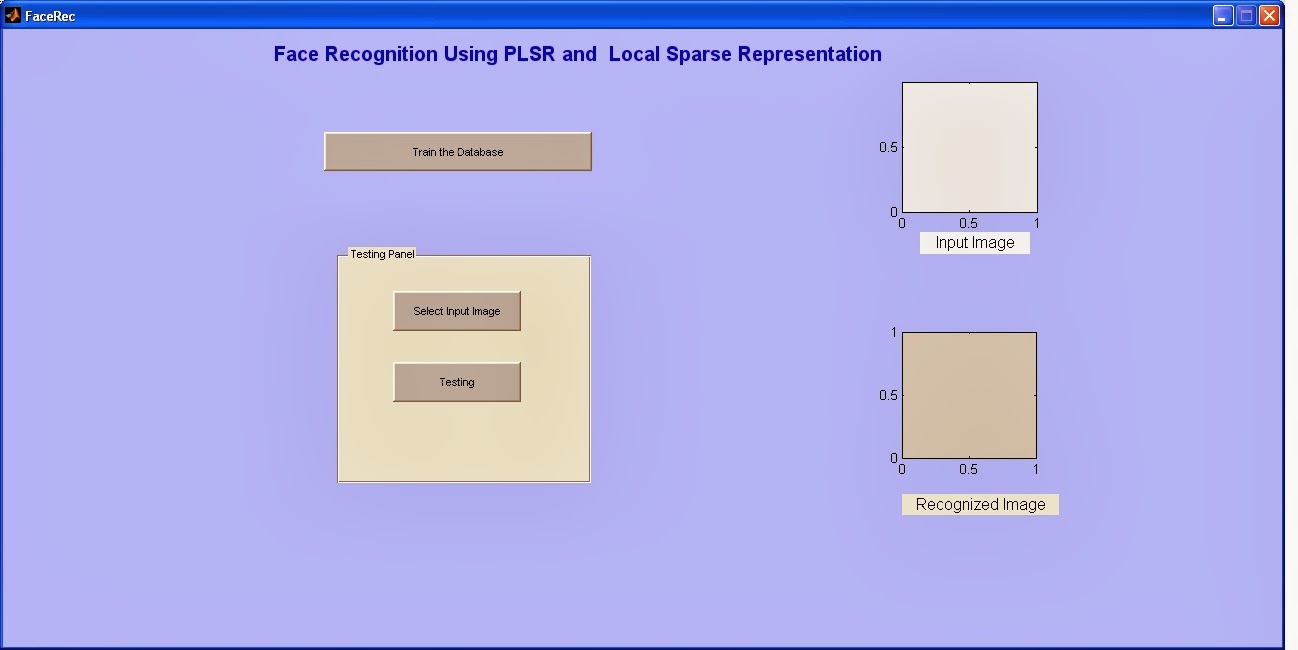
Run the matlab function and add the database images to path and train the images using train button.
Step 3:
Now Select the input image button to locate input image.
Step 4:
Click the Testing button to get the recognized images from database.
Note:
You should download the database before running the code. Instruction to download the database is in the comment section of the file.